8.18.26 Under Construction. Numerous pages are still being finalized, and some links may not work. But the current draft page content still provides a good overview of what we are doing and where we are going.
The Great Rebirth is a transition map for moving from converging systemic crisis toward resilience, intelligent simplification, institutional learning, cooperation, and long-term civilizational renewal. It is about a civilization-level transition.
The Great Reckoning and the Great Rebirth are not two tidy historical eras separated by a date on a calendar. They are overlapping civilization-scale processes. In one place, institutions may be deteriorating while another community is already building more resilient food systems, better governance, or new forms of cooperation.
This page maps the space between diagnosis and renewal: how humanity can reduce suffering, preserve critical knowledge and capabilities, adapt to unavoidable change, and increase the probability that disruption becomes a catalyst for learning rather than a conveyor belt into repeated failure.

On this page
Adaptive vs. chaotic simplification
Preserve, transform, let go, create
1. Two Overlapping Historical Processes
a. The Great Reckoning
The period in which ecological overshoot, climate destabilization, resource constraints, institutional dysfunction, economic fragility, geopolitical stress, technological risks, information disorder, and other systemic problems increasingly impose consequences that can no longer be postponed.Read the full Great Reckoning page
b. Humanity's Great Rebirth
The overlapping constructive process through which societies attempt to preserve what is worth preserving while creating more adaptive, cooperative, ecologically responsible, truthful, resilient, and life-affirming institutions and cultures.\Read the full Great Rebirth page
The central idea
The Reckoning describes the confrontation with accumulated,deferred, and delayed global consequences. The Rebirth describes the constructive response. They overlap because adaptation begins before crisis ends, and because no society is likely to transform all of its systems simultaneously.

2. The Great Transition Map
The sequence below is a conceptual map, not a rigid chronology:
Great Acceleration → Ecological Overshoot + Civilizational Dysfunction → Polycrisis / Metacrisis → Great Reckoning → Adaptation, Simplification, Reform, Breakdown, or Regeneration → Great Rebirth
| Stage | Dominant dynamic | Key question |
|---|---|---|
| Great Acceleration | Rapid growth of population, consumption, energy use, extraction, infrastructure, finance, technology, and environmental impacts. | How did civilization become so powerful and so dependent on continued throughput? |
| Overshoot and dysfunction | Ecological demand exceeds regenerative capacity while institutions externalize costs and reward short-horizon behavior. | Which systems are consuming their foundations? |
| Polycrisis and metacrisis | Crises interact and amplify each other while deeper institutional and cultural causes repeatedly regenerate them. | Why do separate interventions keep failing to solve the whole problem? |
| Great Reckoning | Accumulated denied, deferred, or delayed consequences become increasingly unavoidable. | What must we stop denying, externalizing, or postponing? |
| Transition zone | Competing pathways of adaptation, coercion, simplification, reform, innovation, migration, collapse, and regeneration emerge. | Which responses preserve human and ecological wellbeing? |
| Great Rebirth | Successful practices scale into more durable institutions, cultures, technologies, and ways of living. | What kind of civilization deserves to survive and can actually remain viable? |
3. What Makes a Great Rebirth Possible?
The Great Rebirth does not emerge automatically from crisis. Severe disruption can just as easily produce fear, conflict, authoritarianism, scapegoating, institutional collapse, and a frantic effort to restore the very systems that helped create the crisis.
A constructive transition becomes more likely when societies preserve and strengthen several capacities at the same time.
Truth and Reliable Knowledge
People need accurate information about changing conditions, risks, available resources, and the consequences of different choices. When information systems become corrupted by propaganda, commercial manipulation, political distortion, vested financial interests, or wishful thinking, societies lose their ability to adapt intelligently.
Better Thinking
Complex modern and polycrisis problems require systems thinking, dialectical thinking (DMAP), probabilistic reasoning, evidence evaluation, and the ability to distinguish root causes from symptoms. Good intentions are not enough when the system producing the problem is poorly understood.
Cooperation
Human beings repeatedly achieve extraordinary things through cooperation, but cooperation remains fragile when free-riding, exploitation, corruption, and concentrated power are allowed to become more rewarding than contribution.
Institutions That Can Learn
Institutions need trustworthy feedback, transparent measurement, accountability, anti-capture safeguards, and the ability to change rules when evidence shows that existing policies are failing.
Ecological Reality
No political ideology, economic theory, or technological enthusiasm eliminates the Earth's ecological limits. Successful renewal must eventually fit human activity within the regenerative capacities and stability conditions of the biosphere.
Purpose and Imagination
People endure difficult transitions more successfully when they can see what they are trying to protect and what they are trying to create. A compelling positive vision can turn sacrifice from meaningless loss into purposeful investment in a better future.

The core principle
Crisis alone does not produce wisdom. Crisis creates pressure. Whether that pressure produces breakdown or renewal depends heavily on the quality of information, leadership, institutions, cooperation, values, preparation, and choices available when the pressure arrives.
4. The Future Branches, It Does Not March in a Straight Line
Under stress, civilization can move along several pathways at once. Recognizing these branches helps prevent both doom determinism and automatic-progress fantasies.
1. Denial, deferral, and delay
Institutions protect existing interests, externalize costs, weaken inconvenient information, and postpone structural change. This can preserve short-term stability while increasing later adjustment costs.2. Authoritarian stabilization
Governments may respond to disorder by increasing surveillance, coercion, censorship, militarization, or centralized allocation. Such measures can sometimes maintain order temporarily, but they impose a heavy societital cost overhead and can reduce feedback quality, legitimacy, and adaptive learning.3. Chaotic simplification
Complexity declines through infrastructure failure, economic contraction, institutional breakdown, resource shortage, or conflict. Essential functions may be lost along with unnecessary complexity.4. Adaptive simplification
Societies intentionally reduce fragile or low-value complexity while protecting health, food, water, knowledge, rights, ecological systems, and high-value technical capabilities.5. Technological substitution
Innovation can improve efficiency, energy systems, agriculture, materials, communication, health, and risk management. But technology cannot repeal physical limits and can create rebound effects or new risks if governance remains dysfunctional.6. Regenerative transformation
Institutions learn from the Great Reckoning, align incentives with long-term consequences, restore commons, improve collective intelligence, and create durable cooperative systems.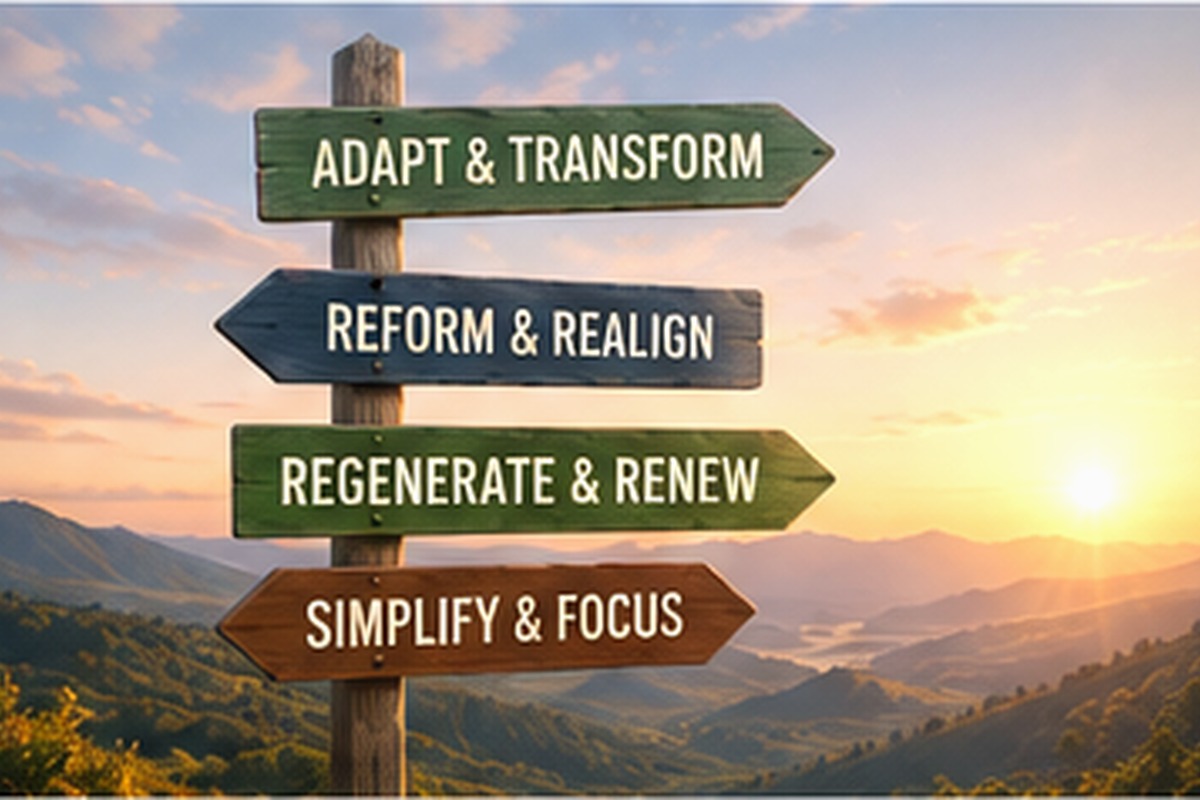
5. Two Very Different Ways to Simplify
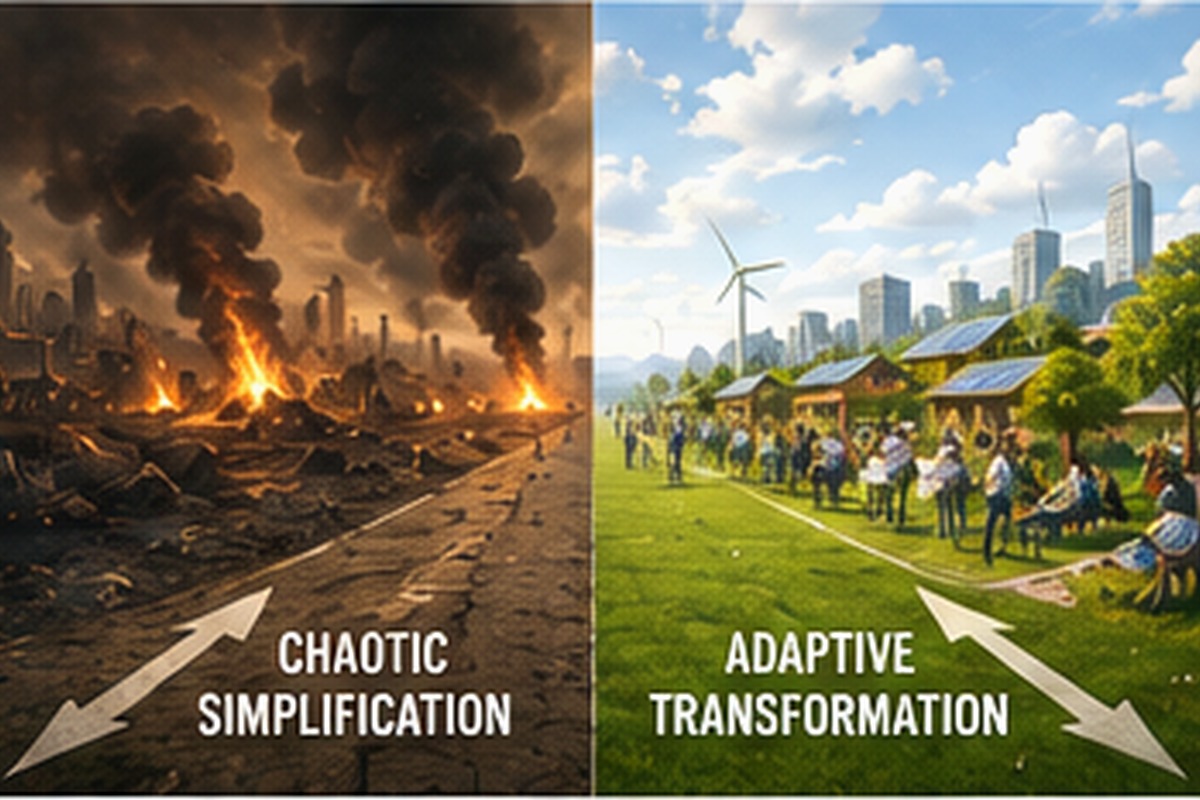
One of the most important distinctions during the Great Reckoning is between chaotic and adaptive simplification. Both can reduce complexity. Their human consequences can be radically different.
| Chaotic Simplification | Adaptive Simplification |
|---|---|
| Complexity is lost through breakdowns, shortages, conflict, disasters, financial failures, or institutional collapses. | Complexity is deliberately reduced where it is expensive, brittle, wasteful, ecologically destructive, or no longer essential. |
| Essential and nonessential systems may fail together. | High-value systems are identified and protected before resources become severely constrained. |
| Knowledge, infrastructure, rights, medicine, education, and public institutions may be lost indiscriminately. | Science, medicine, rights, knowledge, food systems, water systems, communications, and other critical capacities receive priority. |
| Scarcity encourages panic, competition, hoarding, coercion, and conflict. | Preparation, cooperation, fairness, transparent rules, and resilience reduce destructive competition. |
| Change happens primarily because systems fail. | Change happens partly because people recognize limits and redesign systems before failure forces the decision. |
The Transition Challenge
The goal is not to preserve every layer of modern complexity indefinitely. Nor is it to romanticize collapse. The wiser goal is to preserve valuable complexity while intentionally simplifying systems whose ecological costs, fragility, maintenance burden, or declining returns make them increasingly dangerous.
6. What Must Be Preserved Through the Great Reckoning?
Transformation does not mean discarding civilization and starting from a picturesque hut with excellent compost. Much of modernity is worth protecting.
- Scientific knowledge and open inquiry.
- Public-health capability and modern medicine.
- Human rights, due process, pluralism, and protections against arbitrary power.
- Reliable food, water, sanitation, energy, and communications infrastructure.
- Libraries, archives, technical manuals, cultural memory, and educational institutions.
- High-value technologies that reduce suffering or ecological impact.
- Democratic accountability and transparent institutions where they function.
- Local knowledge, indigenous ecological knowledge, and place-based competence.
- Networks of trust, mutual aid, civil society, and legitimate cooperation.
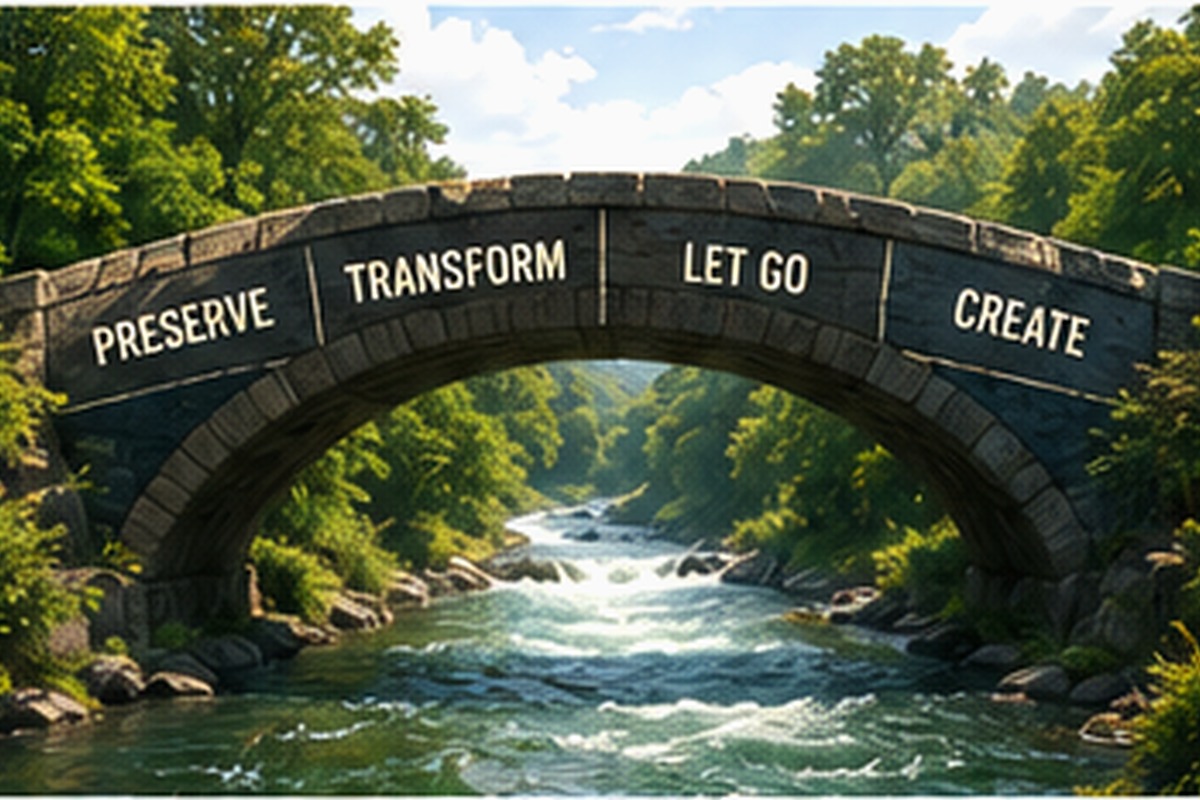
7. Preserve, Transform, Let Go, and Create
Moving through the Great Reckoning requires more than deciding what is good and what is bad. Civilization contains institutions and technologies that deserve very different responses.
A useful transition framework asks four questions.
1. What Must We Preserve?
Preserve science, useful technology, medicine, education, cultural memory, human rights, democratic accountability, critical infrastructure, ecological knowledge, and other achievements that reduce suffering and expand human possibility.
2. What Must We Transform?
Many economic, political, technological, agricultural, financial, and governance systems provide essential benefits but contain incentive structures that produce overshoot, inequality, capture, fragility, or environmental destruction. These systems need redesign rather than simple abandonment.
3. What Must We Let Go?
Some practices may no longer be compatible with long-term survival and wellbeing: unlimited material throughput, systematic ecological externalization, profitable pollution, institutionalized free-riding, extreme short-termism, and economic models that require endless physical expansion on a finite planet.
4. What Must We Create?
Humanity will need new combinations of institutions, technologies, cultural practices, education systems, governance safeguards, resilient communities, and forms of cooperation specifically designed for ecological limits and long-horizon responsibility.
A better question than "Should civilization survive?"
Which parts of civilization should survive, which must change, which should end, and what must be invented that does not yet exist?
That question turns the Great Reckoning from a debate about saving or abandoning "civilization" into the much more useful task of intelligently selecting what we carry forward.
8. What Must Change?
The Great Rebirth cannot simply restore the same incentive structures that produced the Great Reckoning. Reconstruction without learning is just the prequel getting another season.
| From | Toward |
|---|---|
| Externalizing ecological and social costs | Consequence capture: decision-makers bear meaningful effects of their choices. |
| Unlimited throughput as a default measure of success | Wellbeing, resilience, ecological viability, quality, durability, and sufficiency. |
| Rules easily captured by concentrated power | Governance closure, transparency, independent oversight, distributed checks, and anti-capture mechanisms. |
| Rewards for free-riding and extraction | Support for genuine contributors, verification, proportionate enforcement, and commons integrity. |
| Short-term optimization | Long-horizon planning with explicit attention to future generations and ecological constraints. |
| Fragmented specialties | Systems, dialectical, interdisciplinary, and cross-scale thinking. |
| Brittle global efficiency | Strategic redundancy, regional resilience, and diversified supply and emergency backups where necessary. |
| Information systems optimized for attention and manipulation | Information environments designed to improve truth-seeking, accountability, and collective learning. |
9. Rebirth Must Work at Several Scales at Once
Progressive evolution repeatedly stabilizes cooperation when mechanisms emerge that suppress destructive within-unit competition and align lower-level incentives with the viability of the larger whole. Human civilization faces the same design problem at unprecedented scale.
Individual
Better rational thinking, emotional regulation, practical skills, health, ecological literacy, ethical responsibility, and the ability to cooperate across difference.Household and community
Mutual aid, food and water security, local energy, emergency readiness, trust networks, deliberative processes, and protection of vulnerable members.City and region
Land use, infrastructure, water, transportation, housing, public health, ecosystem restoration, migration planning, and regional resource security.Nation
Fiscal capacity, law, rights, national infrastructure, redistribution, anti-corruption, industrial policy, energy transition, disaster response, and long-term planning.Planetary
Climate stabilization, biodiversity protection, ocean governance, pandemic risk, AI and biotechnology governance, nuclear risk, financial contagion, and other commons no nation can manage alone.Intergenerational
Institutions must represent people who cannot vote yet but will inherit the atmospheric, ecological, fiscal, technological, and infrastructural consequences of today's decisions.
11. How Do We Know Whether We Are Moving Toward Rebirth?
Calling something regenerative does not make it regenerative. The following tests help distinguish real civilizational learning from tasteful rebranding.
- Ecological viability: Does the system reduce overshoot and protect regenerative capacity?
- Consequence capture: Do actors bear meaningful consequences of harmful decisions?
- Anti-capture: Can concentrated interests rewrite the rules for themselves?
- Free-rider containment: Are deliberate exploiters prevented from systematically outperforming contributors?
- Fairness and legitimacy: Are burdens and benefits distributed in ways people can reasonably accept?
- Feedback quality: Can bad news travel upward without punishment or distortion?
- Adaptive capacity: Can rules change as conditions and evidence change?
- Scale match: Is the problem being governed at the scale where causes and consequences actually occur?
- Resilience: Does the system retain essential functions under stress without depending on a single brittle pathway?
- Human development: Does it improve the capabilities, dignity, knowledge, and meaningful agency of people rather than merely preserving institutional machinery?

10. Hope Is Not Naive When It Changes What We Do
Hope becomes dangerous when it means refusing to examine bad news because we prefer a comforting story. But the opposite mistake is equally damaging: believing that recognizing severe risks requires concluding that constructive action is pointless.
Practical hope is different.
Practical hope does not require certainty that humanity will succeed. It requires recognizing that different choices still produce different outcomes.
Every fraction of avoided warming matters. Every ecosystem protected matters. Every community made more resilient matters. Every institution that becomes harder to capture matters. Every improvement in food, water, energy, health, education, governance, and cooperation broadens the range of futures humanity can still navigate.
Hope as a strategy
Grounded hope combines realism about danger with confidence that meaningful choices remain.
It asks neither "Will everything be all right?" nor "Is everything doomed?"
It asks: What can still be protected? What harm can still be prevented? What capabilities can still be strengthened? And what better systems can we begin building now?

The Great Rebirth begins wherever people answer those questions with competent action.
13. AI Prompts for Transition Planning
On many pages, we provide AI prompts to help you use, evaluate the usefulness, and truthfulness of what we are presenting.
Prompt 1: "For my community, map six possible responses to polycrisis: denial/delay, authoritarian stabilization, chaotic simplification, adaptive simplification, technological substitution, and regenerative transformation. Estimate major benefits, risks, dependencies, and early warning indicators for each."
Prompt 2: "Identify the ten most important capabilities our community should preserve through severe disruption. Distinguish critical functions from expensive complexity that could be simplified."Prompt 3: "Design a transition strategy that reduces ecological overshoot while protecting vulnerable people and maintaining legitimacy. Explicitly test for false either/or assumptions and propose both-and solutions where viable."
Prompt 4: "Red-team this proposed resilience plan for capture, free-riding, information distortion, unfair burden shifting, resource overshoot, and failure under prolonged stress.
12. Our Role in the Great Transition
No individual, organization, government, or generation can control the entire Great Reckoning. That does not mean individuals and organizations are powerless. Our realistic task is to increase the probability of better outcomes within the parts of the system we can influence.
See Reality Clearly
Seek high-quality evidence. Track changing risks. Question convenient assumptions. Distinguish what is known, uncertain, disputed, or still speculative.
Improve How We Think
Use systems thinking, dialectical thinking, probability, red teaming, scenario analysis, and evidence testing to avoid simplistic solutions to complex problems.
Prepare Wisely
Increase household, organizational, and community resilience before emergencies make preparation harder, more expensive, or impossible.
Strengthen Cooperation
Build trustworthy relationships, fair rules, transparent decision-making, and institutions capable of containing exploitation and free-riding.
Protect What Matters
Preserve people, ecosystems, knowledge, institutions, freedoms, and capabilities that future generations will need to recover and flourish.
Build What Comes Next
Experiment with regenerative agriculture, resilient communities, improved governance, ecological economics, education reform, cooperative institutions, and other practical models that can be tested and expanded.

We do not need the entire map before taking the next step
History is rarely kind enough to provide a complete instruction manual before major transitions. We can still identify directions that reduce catastrophic risk, strengthen resilience, protect human dignity, restore ecological systems, and improve our capacity to cooperate.
The Great Rebirth becomes real through millions of people making decisions that move systems in those directions.
14. Frequently Asked Questions
Do the Reckoning and Rebirth happen sequentially?
No. They overlap. Successful adaptation and institutional innovation can begin while other systems are still deteriorating.Is the Great Rebirth guaranteed?
No. It is a possibility and a project, not a prophecy. Evolutionary progress is local, conditional, reversible, and never a moral guarantee.
Does simplification mean abandoning advanced technology?
No. Intelligent simplification means preserving high-value complexity while reducing brittle, low-return, or ecologically destructive complexity. A resilient civilization may be technologically sophisticated while using fewer materials and less energy per unit of wellbeing.
Can local communities solve global problems?
Not alone. Local resilience is essential, but atmospheric climate, oceans, pandemics, nuclear risks, global finance, and some technological risks require national and international coordination. The viable answer is multi-scale cooperation.

15. Related Frameworks and Further Reading
- Cascade Institute — polycrisis and systemic-risk analysis.
- Metacrisis.info — deeper generators of recurring global crises.
- The Great Simplification — energy, resources, ecology, economics, and human behavior.
- Great Transition Initiative — pathways toward planetary-scale civilizational transformation.
- Club of Rome: Planetary Emergency Plan.
- Global Footprint Network — ecological footprint, biocapacity, and overshoot.
- Post Carbon Institute — energy, resilience, limits, and community adaptation.
16. The Next Page: What Would a Great Rebirth Actually Require?
A transition map tells us where choices branch. The harder question is what a successful destination would look like without turning the Great Rebirth into a utopian wish list. The Great Rebirth page develops operational principles for ecological viability, cooperative governance, consequence capture, rational thinking, resilience, human development, and institutional learning.
Continue to learn more about Humanity's Great Rebirth.
The Transition Is Already Underway
The relevant choice is not whether history changes. It is whether societies learn quickly enough to influence how they change, what they preserve, whose suffering they reduce, and what forms of civilization emerge from the pressure.\
Showing 1 reaction